

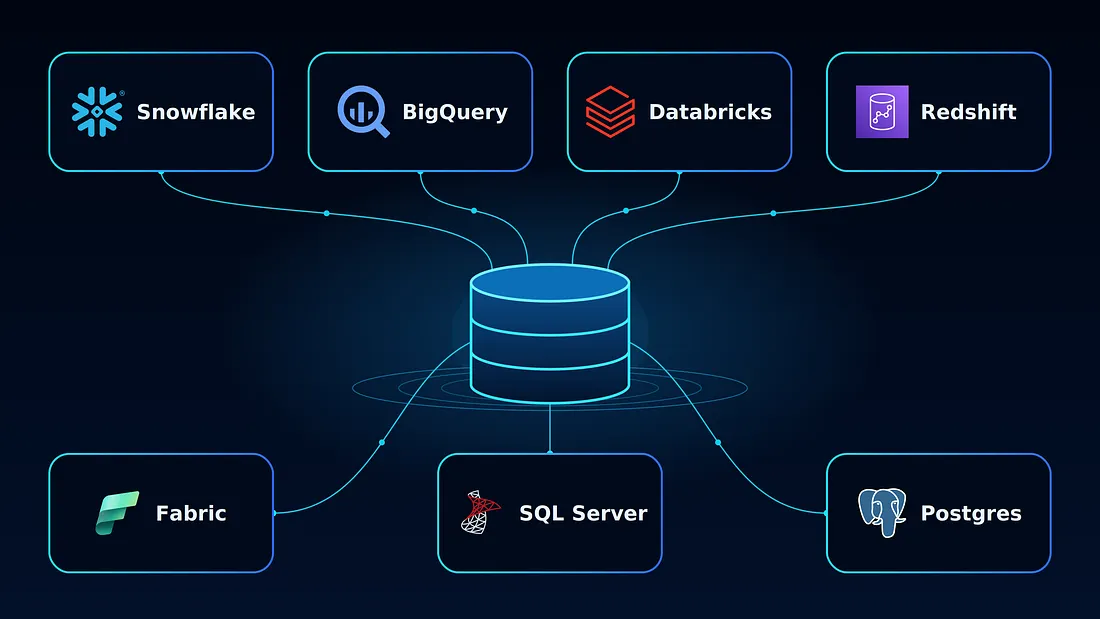
“It's time we start using a data warehouse”.
It probably is, and has been for a while. You should've stopped plugging PowerBI into your production database a long time ago, and Excel can only handle so much data until it becomes a headache to manage. For any business looking to start caring about their data, a data warehouse is the first pillar that needs to be in place to ensure accurate reporting and informed decision making.
With everything we read in 2026 about all the fancy capabilities of modern data platforms like Snowflake, Databricks, BigQuery, etc, it's hard to not feel like these are your only options if you want to start managing your data more effectively. And for a lot of teams, it does make sense as the next step. These modern cloud platforms have optimized to a degree where they're able to offer quite a reasonable price considering their immense capabilities.
Powerful SaaS cloud warehouses aren't always the answer
But if you're the one data guy at a ten person company, and not expecting to scale at a rapid pace, you might not necessarily need Databricks. What you do need is a single source of truth for your data so that you don't have five different dashboards each with different definitions of what a key business metric means. You need one place where your ERP, CRM, and website traffic data lives so it can all be governed with the same controls. You don't necessarily need Databricks for that.
This could be as simple as creating a read-replica of your transactional database and setting up a simple dbt project to keep the transformations outside your BI tool. It could also be setting up a new instance of Postgres or MySQL and connecting your sources to that new database and using this as your data warehouse. It may not have the fancy AI-native functionality or easily scalable compute like the modern vendors, but it works great for fulfilling the underlying purpose of a data warehouse: storing historical data in one place, ensuring data is governed, and defining a single source of truth for your business to make decisions with.
These traditional database platforms are optimized for OLTP (fast inserts/updates for production databases) rather than OLAP (reading massive amounts of data efficiently), but this doesn't matter too much when you don't have any more than about a terabyte of data. It's typically much more cost effective to run these tools than migrating over to a SaaS solution when operating at a small scale.
When platforms like Snowflake make sense
However, if you're expecting to scale your business, or if you're finding it's not worth the time to manage an on-prem database software, it makes a lot of sense to migrate. I've found that Snowflake for example has a low learning curve for users that already know SQL and have used other database tools, and the separated storage and compute allows for more flexibility, scalability, and cost efficiency. Snowflake also has high compatibility with other tools in the modern data stack like dbt, Fivetran, and almost every BI tool.
Perhaps the biggest benefit is the low overhead required to manage platforms like Snowflake. More compute or storage can be had from just a few clicks of a button, and you don't pay for compute when the virtual warehouse is suspended. When your business is looking to scale fast, you won't have to worry about provisioning more servers or planning for another migration.
Making the Right Call
As you could probably guess...there's no right or wrong answer for what kind of data warehouse to adopt. In short: if you're a small business with GB scale data running on-prem and looking to get more insights from your data, spinning up another database to connect your sources and do some transformations might be all you need. If you're looking to scale fast, go all-in on AI, and get high compatibility with other tools in the modern data stack, platforms like Snowflake are a great choice.